People fill in timesheets. AI fills in TokenSheets.
Manage AI engineering the way you manage people engineering.
Both are assigned to projects. Projects carry an engineering budget — humans in time,
AI in tokens. You track burn toward completion, and when the work needs more, a manager reviews and
extends it. TokenScope is the part that does it for your AI developers — and the people who manage them.
A developer logs time. Time bills to a project. The project has a budget. A manager watches the burn and tops it up when the work justifies it.
=
AI engineering
TokenSheets → Projects → Budget (tokens)
An AI developer emits tokens. Tokens attribute to a project. The project has a token budget. The same manager watches the same burn — and tops it up the same way.
What it looks like
Six surfaces, one paradigm
Captured from the synthetic demo estate — fictitious people, fictitious clients,
data generated through the real ingestion pipeline.
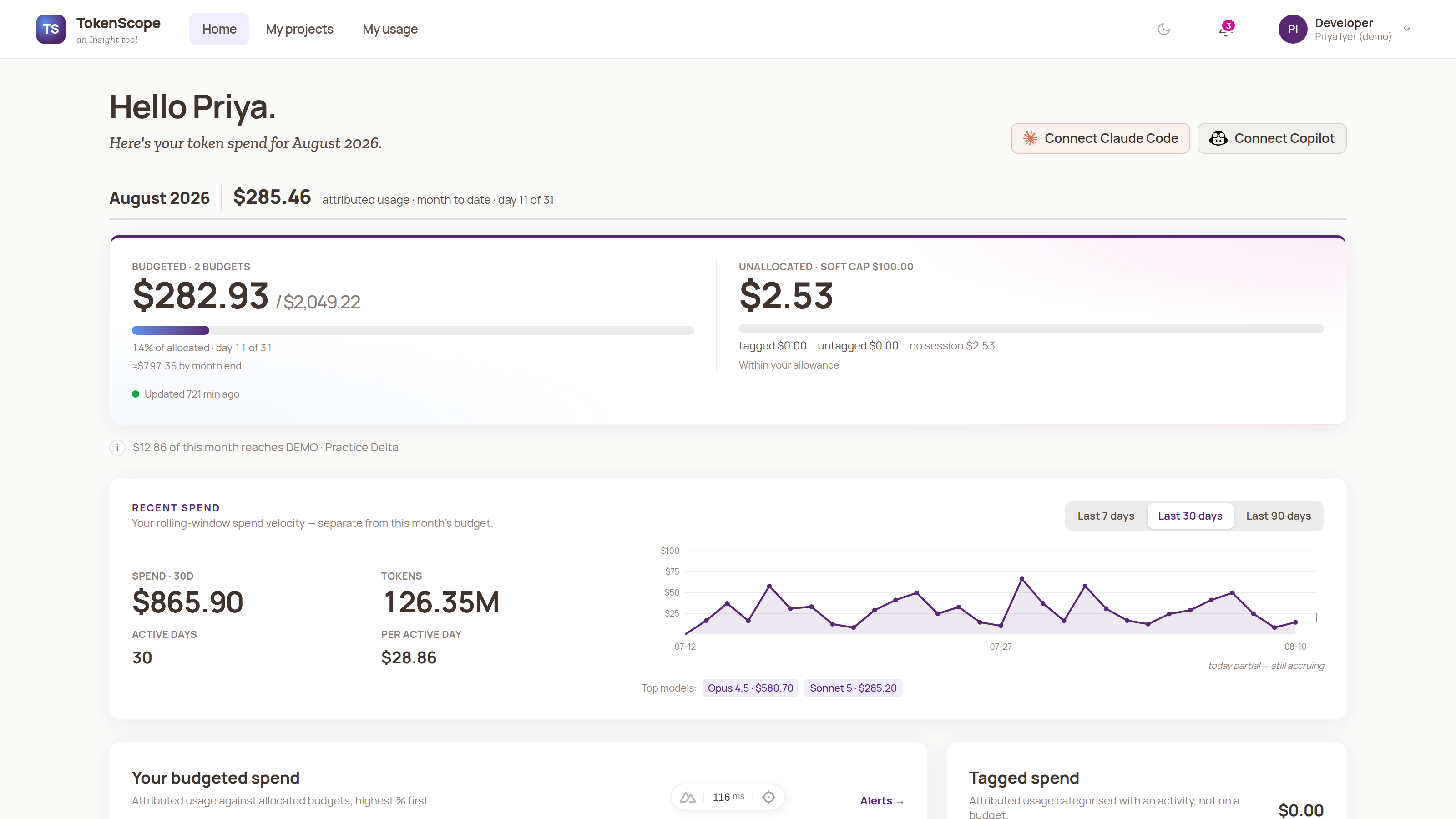
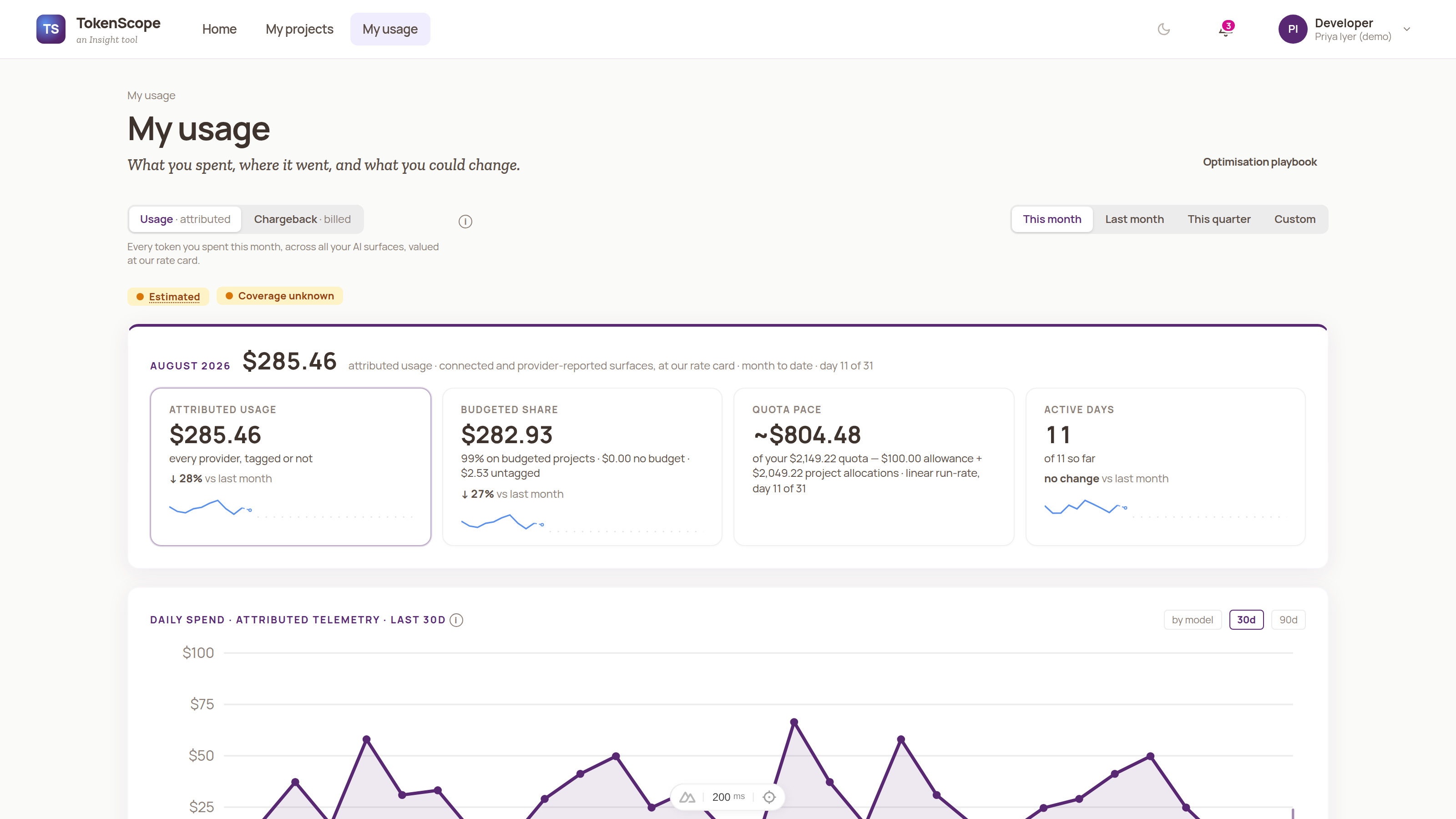
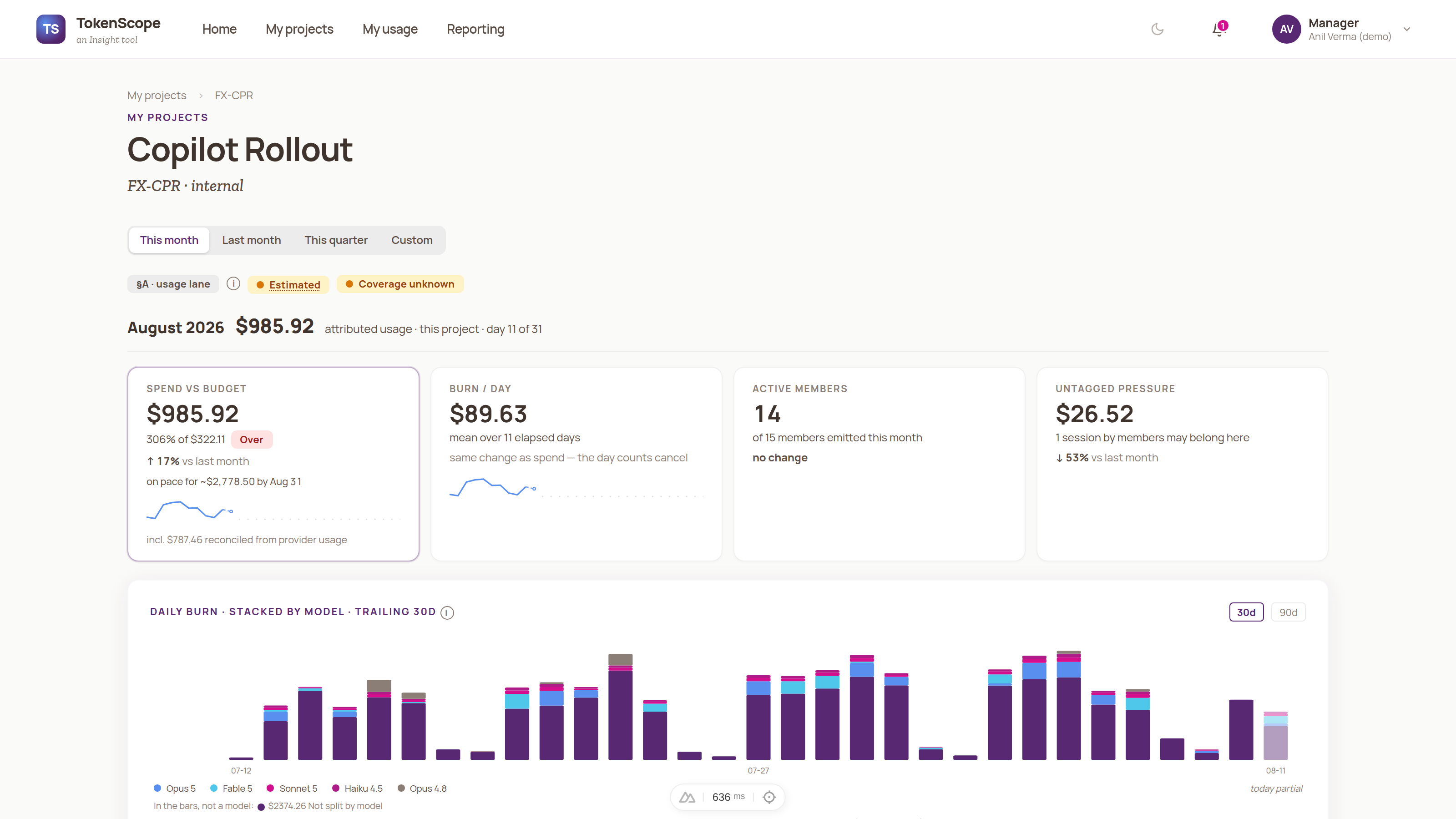
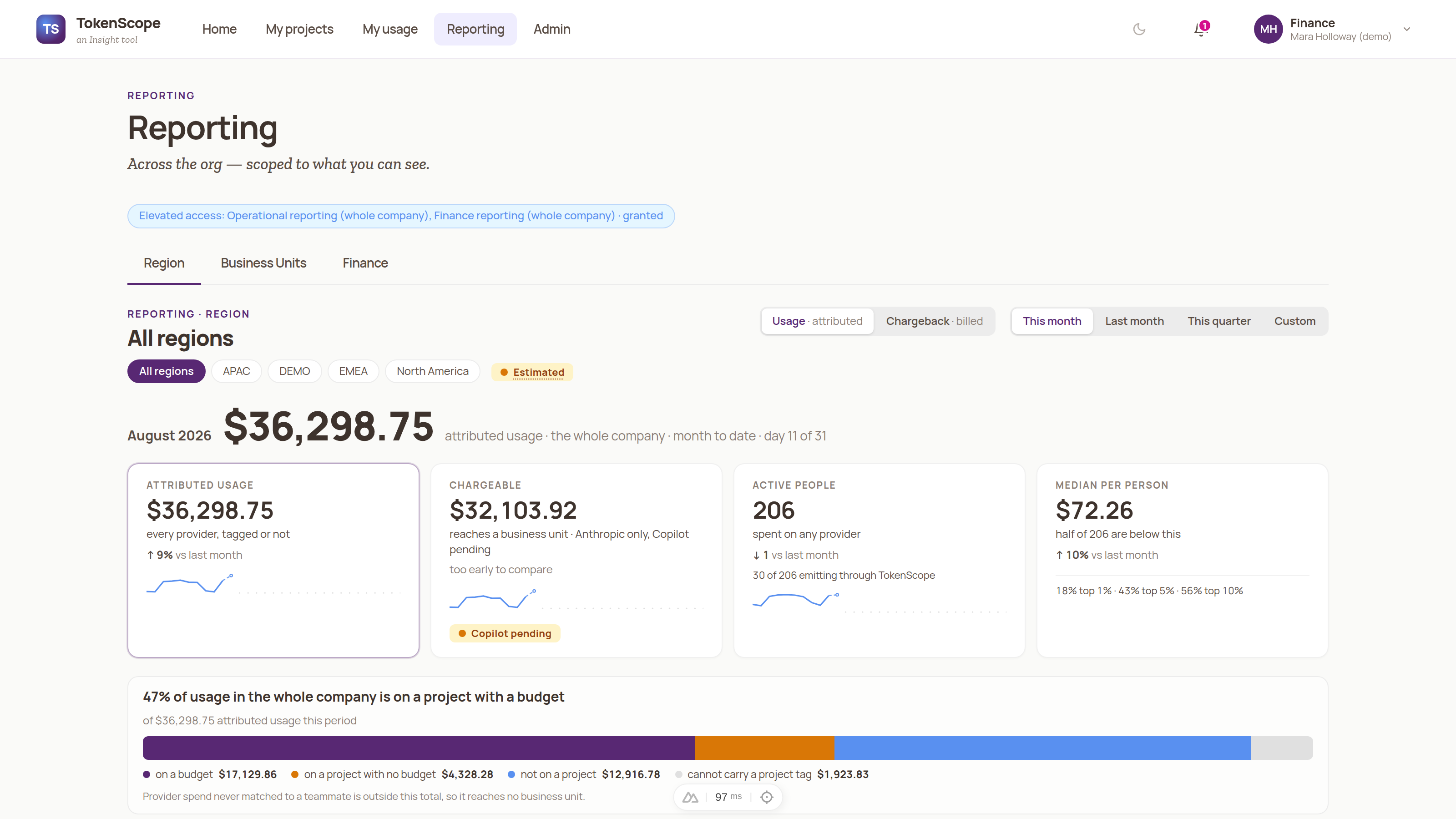
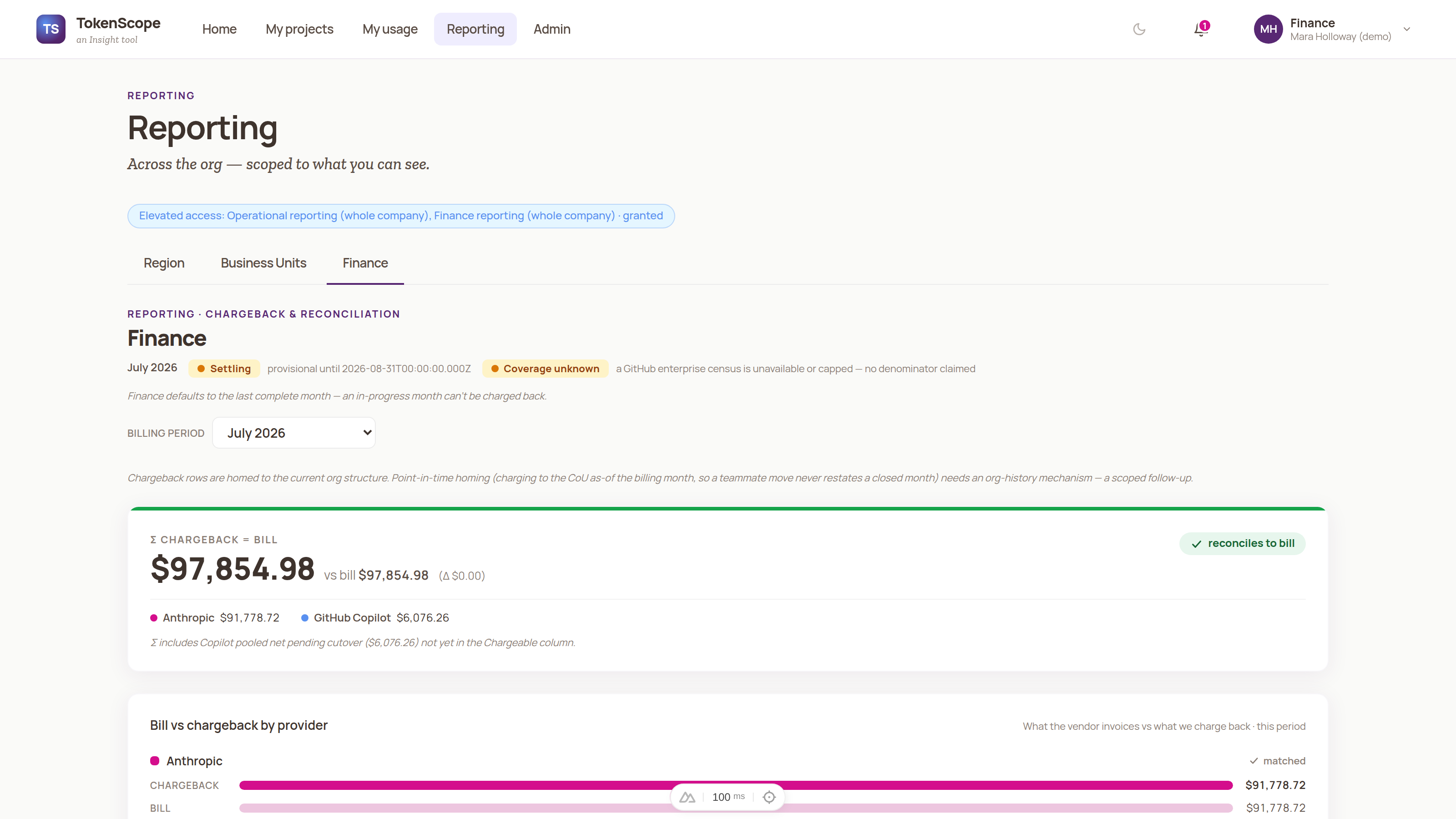
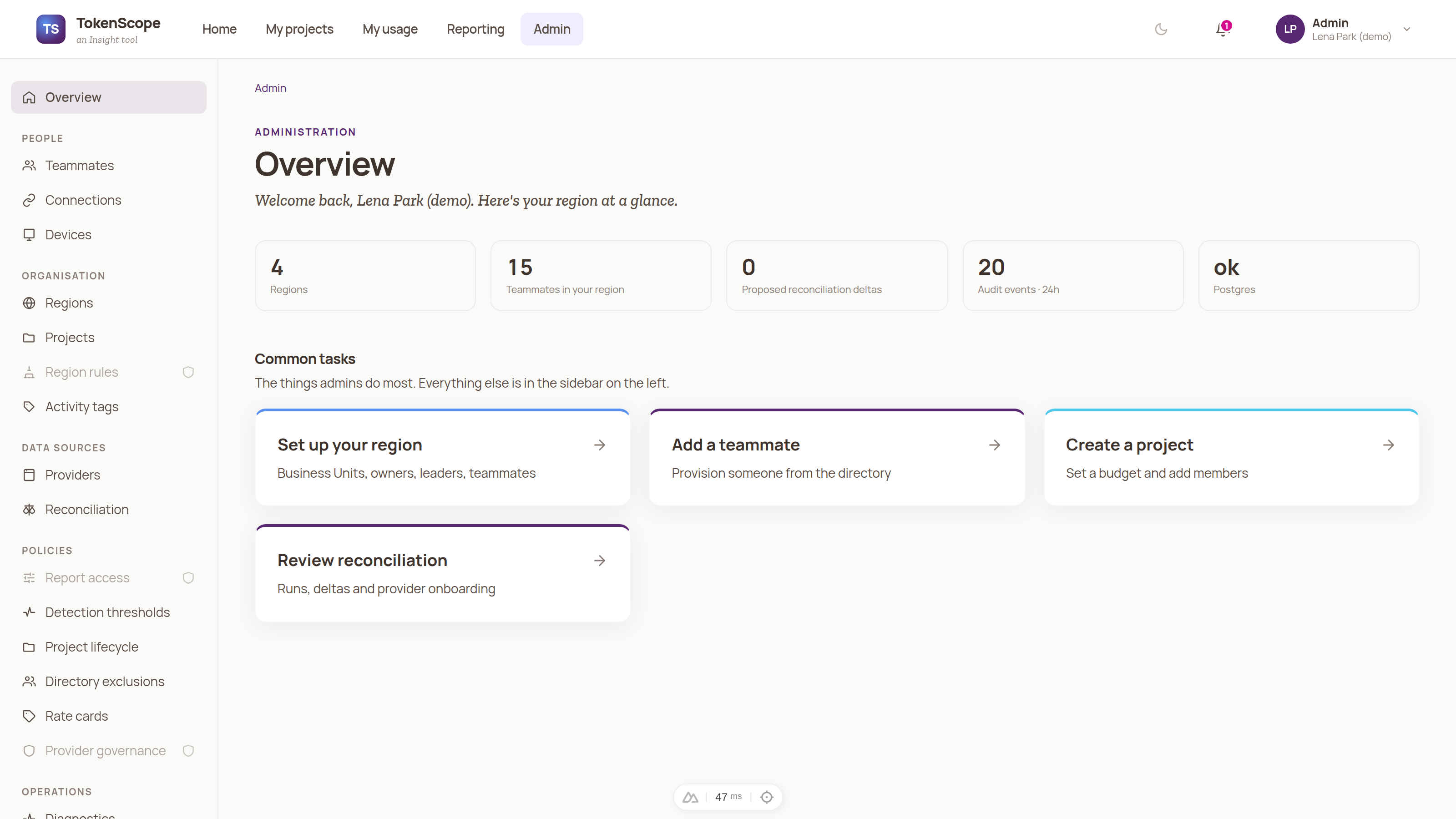
Developer dashboardMonth spend against budget, connect nudges, rolling velocity.My usageWhere it went, quota pace, and what you could change.A projectBudget vs burn, per-model daily stack, every contributor.ReportingThe whole company, region by region, coverage made explicit.FinanceChargeback reconciling to the provider bill, to the cent.AdminOrg setup, policies, and data-source operations in one place.
Every figure above is synthetic, and every card is real product behaviour.
The discipline
Two lenses, never confused
TokenScope keeps two concerns rigorously separate — baked into the schema, not a reporting toggle.
It's the difference between a tool people trust and a tool people game.
§A · Usage
Usage completeness — "My usage"
What a person actually consumed, whether or not their tools were instrumented. This is
attribution, not chargeback — and it must never read below the provider's own truth.
§B · Billing
Billing & chargeback
The cost-of-record, charged at the grain the provider actually bills — per-user for some,
pooled-per-cost-centre for others — and displayed at the grain people care about.
Showing usage is not the same as charging for it. Keeping that line clean is a first-class design rule.
How it attributes
Every token gets an owner, a claim, and a home
A server-minted, unspoofable instance identity binds emitted telemetry to a real person —
then each token is priced by a rate card into an attribution record.
Claude Code & GitHub Copilot CLI emit through one OAuth-2.1 MCP server. Zero-touch: emit now, attribute later.
🎯
Reconciled attribution
A batch truth-poller runs alongside the streaming OTel signal, so usage completeness holds even for people who never enrolled.
📊
Budgets with gravity
A base allowance for exploration vs a real project budget for budgeted work — volume & velocity limits that teach, not gates that block.
🧭
Reporting scopes & roles
Developer "my usage", manager budget-burn, Global-finance chargeback, cost-centre P&L — role-based access, region-scoped to platform-wide.
🏷️
Tag proposes, membership disposes
Untagged spend is one-click assignable after the fact. Project claims are membership-gated, not self-asserted.
🔒
Deploy your way
Same Bicep, two modes: public sandbox with Front Door, or fully VNet-integrated with private endpoints throughout.
Honest fit
Is this for you?
TokenScope is opinionated. It's for organisations and teams that want to treat AI engineering as
budgeted, project-assigned, managed engineering work — the TokenSheets paradigm. If that's your
model, it should fit cleanly. If it isn't, it won't — and that's fine.
Read the principles so you know exactly what you're adopting.